My life has been to seek the Absolute Truth of God; to help others find the real purpose of their lives... Attempt to make this or where ever I am; better for my having been there! Amen!
** Love is supreme and everlasting, it is an eternal connection between beings! **
Date: 4/9/2019
Love is the key to Eternity!
Love is an eternal action that exists because, The Lord God Almighty, first loved us - which allows us to love others!
If you would just stop and check some of the many things connected to True Love - you would change your direction and evil ways in this earthly existence! To do otherwise is a sin against all Almighty God represents in this earthly life!
Love is: patient, and kind never boastful, or proud. Love does not delight in evil and rejoices with the whole truth. Love is not easily angered nor keeps any record of wrongs. Love does not dishonor others nor is not self-seeking. Love always protects and displays trust. It always hopes, and preserves. Because Love never fails!
This list is found in the Bible find it to seek to understand it's many meanings. When you seek the truth you shall find it - your life will change if and when you come to follow the admonition of love!
Love is supreme and everlasting, it is an eternal connection between beings! Seek to love and become part of God's eternal triangle of Love and learn respect for others!
This is one of the keys to the Kingdom of God; it exists to help ensure that you do not forget the real reason for true relationships. While we do not know exactly when our final moment on this earth will come, only love will give you the gateway to the splendor of Heaven!
Choose this day whom you will love and serve forever, then you can enjoy this Blessed Relationship forever!
** Love is supreme and everlasting, it is an eternal connection between beings! ** Date: 4/9/2019 Love is the key to Eternity!
Blog: My Unusual Road of Life.... by kerminator
Love is the key to Eternity!
** Love is supreme and everlasting, it is an eternal connection between beings! ** Date: 4/9/2019
Love is an eternal action that exists because, The Lord God Almighty, first loved us - which allows us to love others!
If you would just stop and check some of the many things connected to True Love - you would change your direction and evil ways in this earthly existence! To do otherwise is a sin against all Almighty God represents in this earthly life!
Love is: patient, and kind never boastful, or proud. Love does not delight in evil and rejoices with the whole truth. Love is not easily angered nor keeps any record of wrongs. Love does not dishonor others nor is not self-seeking. Love always protects and displays trust. It always hopes, and preserves. Because Love never fails!
This list is found in the Bible find it to seek to understand it's many meanings. When you seek the truth you shall find it - your life will change if and when you come to follow the admonition of love!
Love is supreme and everlasting, it is an eternal connection between beings! Seek to love and become part of God's eternal triangle of Love and learn respect for others!
This is one of the keys to the Kingdom of God; it exists to help ensure that you do not forget the real reason for true relationships. While we do not know exactly when our final moment on this earth will come, only love will give you the gateway to the splendor of Heaven!
Choose this day whom you will love and serve forever, then you can enjoy this Blessed Relationship forever!
There’s no single solution for eating the right mix of carbohydrates, fats, and proteins. Here’s how to find your personal optimal mix to get fit and have great energy.
From the mid-20th century up until the 1990's, the standard medical dogma was that low-fat, high-carb diets were the way to go. It helped that the arguments in favor of this diet were very straightforward: fat has nine calories per gram, while carbohydrates only have four, so fat should be much easier to overeat. Additionally, dietary fat can be transported straight to your fatty tissue for storage, while dietary carbohydrates have to be processed by the liver. So eating fat should, it seems, lead to fat gain more easily than eating carbohydrates.
Beginning in the 90’s, opinion began to swing in the other direction, towards low-carb dieting. Low-carb advocates like Dr. Atkins pointed out that dietary fat is necessary for satiety and steroid hormone (testosterone, estrogen, cortisol, etc) production, and is also needed for structural uses—our brains are largely made of fat, for instance.
The low-carb movement blamed high carbohydrate intakes for the modern obesity epidemic, arguing that eating carbohydrates causes your body to produce insulin, and insulin causes your body to store energy in fatty tissue. Therefore, carbohydrates are more fattening than fat, on a calorie-for-calorie basis. They further blamed insulin for making carb-eaters hungrier, causing them to overeat.
Of course, tests that you do with a typical home blood glucose meter can only tell you so much. They only give you a snapshot of your blood sugar and insulin levels at a single point in time, and only look at some of the factors that determine your carbohydrate tolerance. I’ve had my blood sugar tested a few times, but I don’t rely on it to gauge my carbohydrate tolerance, and I don’t usually urge my clients to get theirs tested either.
In practice, there’s a better and easier way to gauge your carbohydrate tolerance.
The Simple Self-Experiment to Determine How You Should Eat
I’ve devised a simple way of gauging your own carbohydrate tolerance that I recommend to my clients. Because your gut feeling for how you should be eating isn’t very accurate, you get better information by collecting actual data. The way you acquire that data is through a controlled self-experiment.
What you’ll do in this experiment: eat a few meals of different types with three different carb/fat balances, under controlled conditions. After each meal, you’ll measure things like your mood, hunger, and energy level to see which meals make you feel the best.
Here’s a step by step guide for running the experiment.
Step 1: Decide what time of day to eat your test meals
Although you probably eat three meals a day, you should pick just one of those meals to be the one you run your experiment on. As with any experiment, you need to control as many variables as possible, including what time of day you’re eating— so you’ll also want to standardize the time at which your test meals take place. For instance, you might run your tests at breakfast at 8 AM every day, or lunch at 1 PM, or dinner at 6 PM.
Of all these options, I recommend choosing breakfast if at all possible, because it allows you to control for another set of variables: what happened earlier in the day. Breakfast, more so than lunch or dinner, tends to take place under the same conditions almost every day.
Step 2: Determine the macronutrient amounts for each variation
In this experiment, you’ll be testing three diets: low-carb high-fat, low-fat high-carb, and moderate-carb moderate-fat.
After that, you may also want to test other, more specialized diets, like ketogenic, paleo, vegan, or a protein-sparing modified fast. But start with the first three. These can be sustained indefinitely, and don’t require you to completely avoid any particular food. Your results on these three variations will also be helpful information in considering further specialization, should you decide to do so.
You should test each diet at least three times—so your experiment will take at least three days for each diet you’re testing.
We assume that you eat three meals a day, are moderately physically active (light workouts a few days a week), are in pretty average shape, and want to eat to maintain your current weight. Here are some guidelines for what the test meals should look like — for a person who weighs 180 pounds, and for a person who weighs around 130 pounds:
Moderate-fat, moderate-carb:
180 pounds: 50 grams of protein, 35 grams of fat, 90 grams of carbs
130 pounds: 35 grams of protein, 25 grams of fat, 75 grams of carbs
Low-fat, high-carb:
180 pounds: 50 grams of protein, 10 grams of fat, 150 grams of carbs
130 pounds: 35 grams of protein, 5 grams of fat, 125 grams of carbs
Low-carb, high-fat:
180 pounds: 50 grams of protein, 60 grams of fat, 30 grams of carbs
130 pounds: 35 grams of protein, 45 grams of fat, 25 grams of carbs
Note that all of these meals are moderately high in protein, adding up to about .8 grams of protein per day per pound of bodyweight. But we’re keeping the amount of protein consistent: the scope of the experiment is just about fat and carbs.
Of course, you can and should scale these numbers up or down to account for your actual body weight. You don’t need to get too hung up on the exact size of the meals though—it’s okay if they’re a bit bigger or smaller, as long as they maintain roughly the same ratio between protein, fat and carbohydrates as the examples given.
Step 3: Plan your meals
Once you’ve figured out the nutritional contents for your meals, it’s time to plan the specific foods you’ll eat each day. Again, you’ll need at least three meals of each type.
I recommend pre-planning all of your test meals before you start the experiment.
Here are a few examples of each type of meal:
Moderate-fat, moderate-carbohydrate meals
Meal 1: Three soft tacos with beef or pork, cheese, cabbage, and beans. No rice or sour cream.
Meal 2: Club sandwich with wheat bread, chicken, bacon, tomato, and light mayo. Side salad and cup of fruit.
Meal 3: Pulled pork sandwich with two slices of wheat bread and 5 oz pork, 4 oz mac and cheese, 4 oz broccoli, and an apple.
High-fat, low-carbohydrate meals
Meal 1: 6 oz salmon fillet, 8 oz stir-fried vegetables, 4 oz of blueberries
Meal 2: 3 eggs scrambled with ground beef, tomatoes and avocado, 3 oz of strawberries, 3 oz of carrot sticks dipped in peanut or almond butter.
Meal 3: 6 oz of meatloaf with ketchup, side salad with oil or ranch, half an avocado, handful of mixed nuts, one baby orange.
Low-fat, high-carbohydrate meals
Meal 1: Chicken burrito with rice, cabbage, and beans- no cheese, sour cream or avocado. Can of sugared soda or 4 oz of fruit.
Meal 2: 3 eggs scrambled with turkey, lettuce and tomatoes. Small bowl of cereal. Glass of juice.
Meal 3: 8 oz pasta with 5 oz chicken or shrimp, tomato sauce, 6 oz mixed vegetables, and a small piece of fat-free chocolate.
Each of these meals are sized for someone who weighs around 150–160 pounds and is moderately active, and comes out to somewhere between five hundred and seven hundred calories. Scale up or down as needed.
Step 4: Run your experiment
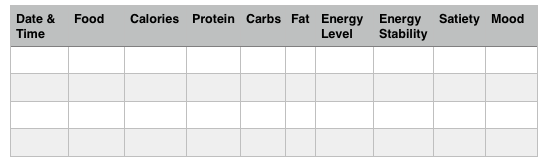
Before you start your experiment, you’ll need a system to track your results. Create a spreadsheet that looks like this:
Illustration by the author.
Each row will be used to record one test meal. Here’s what each column means:
Date and Time: when you ate the meal.
Food: what you ate. Be as precise as possible. “Meatloaf” is not very precise. “6oz meatloaf with 2 tbsp ketchup” is much better, even if the numbers are only guesstimates.
Calories: The number of calories in the meal. Use the calorie-counting app of your choice, or if you need to estimate calories, remember that there are 4 calories per gram of protein and carbohydrate, and 9 calories per gram of fat. (More suggestions for figuring out calories are below.)
Protein, Carbs, and Fat: Protein, carbs, and fat in the number of grams—not calories—of each macronutrient the meal contained.
Energy Level: How much energy you have in the two hours or so following the meal. A “1” would mean you feel sleepy, while a “3” would be a fairly average energy level. A “5” would represent the highest energy level you can realistically experience without stimulants—think “I really want to go for a walk or hit the gym,” not “I just had two energy drinks and now I’m bouncing off the walls.”
Energy Stability: How stable your energy level remains for the six hours or so following the meal, or until your next meal — whichever comes first, and regardless of how high your energy level is overall. For instance, if you feel hyperactive one hour after the meal and sleepy two hours after that, that would be a high energy level but low energy stability. A “5” here represents no noticeable variations in your energy level, a “1” would mean you had a pronounced peak and crash — or crash and recovery — and a “3” would mean you had noticeable but not overly uncomfortable variations in your energy level.
Satiety: How long you go without feeling hungry again. A “1” would mean you feel hungry again within one or two hours, a “3” would mean you feel hungry again within about four hours, and a “5” would mean you don’t feel hungry for six hours or more. Note that if the meal doesn’t satiate your hunger in the first place, it likely just wasn’t big enough.
Mood: How calm and happy you feel over the six hours or so after the meal. A “1” means you feel mildly (non-clinically) depressed, a “3” means you feel good but not great, and a “5” means you feel amazing, almost bordering on hypomanic.
You’ll need to remember to fill out this spreadsheet after every meal. It may help to set several alarms on your phone throughout the day, scheduled to go off shortly after the times when you typically eat your meals.
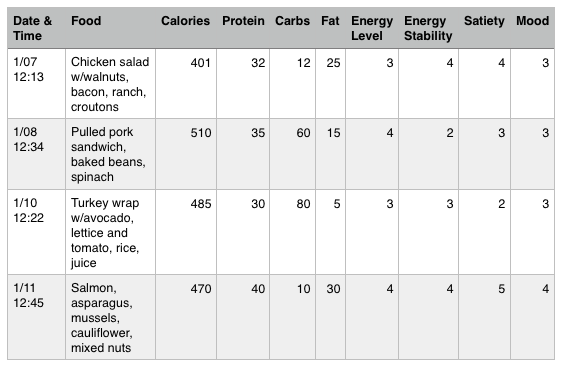
Here’s an example of what the spreadsheet might look like when filled out. In this example, the person getting these results probably responds better to a low-carb diet—although, of course, they’d still want to run the experiment completely to be sure.
Illustration by the author.
As mentioned earlier, you’ll need to eat at least three meals for each diet you’re testing, which means at least nine meals in total. That means the experiment will have to run for at least nine days — and possibly longer — before you can analyze your results.
Step 5: Analyze your results
At the end of the experiment, you should have at least nine meals recorded, each of them on different days, at roughly the same time of day.
Look at the last four columns- energy level, energy stability, satiety, and mood. The best diet for you will be the one that most consistently gives you 4's and 5's in those categories—that’s the diet you should be eating.
Troubleshooting the Experiment
Here are a few common issues people run into, and how you can deal with them.
What if I can’t eat my meal at the usual time or under the usual conditions?
Suppose you’re using breakfast as your test meal, and you usually eat breakfast at home, around 8 AM. But one day, you have early morning meetings and you need to either eat breakfast an hour and a half earlier — and also wake up an hour and a half earlier — or else eat something in the car as you drive to work. What would you do?
The best answer here is to just skip that day. You can always pause the experiment and not have a test meal on any given day if life gets busy and something happens that would disrupt the experiment. It’s better to let the experiment be delayed a day than to let something happen that would confound the results.
What if I don’t know the nutritional content of my food?
First off, this is a good argument for eating the test meals at home. Try your best to buy food with nutritional labels.
That said, you can estimate the nutritional content of your food pretty closely. Measure everything in measuring cups, measuring spoons, or even using a food scale. Look up nutrition data with Google, or the SELF nutrition database.
And remember—you don’t need to be exact. As long as your numbers are within about ten percent accuracy, it’s close enough.
What if two diets are tied for first place?
Run the experiment a little longer. Drop all other diets from the experiment, and test the two possible winners for two or more meals each.
It might also be that your diets aren’t different enough from each other. Remember that the “moderate” diet should have about two or three grams of carbs per gram of fat, the low-fat diet should have ten or more grams of carbs per gram of fat, and the high-fat diet should have almost two grams of fat per gram of carbs. You may need to make your low-fat and high-fat diets a little more extreme to clearly differentiate them.
What Happens When You Eat For Your Carb Tolerance
The odds are, you’ll find out that you’re pretty average. Most people, myself included, feel their best when they eat a moderate-carb, moderate-fat, high-protein diet—which is still a bit lower in carbohydrates than the average American diet.
Almost everyone feels best eating high protein, regardless of their fat/carb balance.
But maybe you’ll be different. Remember Steve from the beginning of this article? After running this experiment, it became clear that he suffered major blood sugar crashes after high-carb meals. I had him limit his carbohydrate intake to 120 grams on workout days and 60 grams on rest days.
He went from feeling tired and grumpy every day to being happy and full of energy—and lost 40 pounds in 4 months. His carb tolerance has since improved somewhat, but he’s still at his best when he keeps his carbohydrate intake on the lower side.
Jenny, another client of mine, had been limiting carbs in order to prepare for a bikini competition. She was already very lean and exercising at a high-intensity level for about ten hours a week. When she ran the experiment, she found she had way more energy when she added some healthy carbs like rice, beans, potatoes, and fruit to her meals.
She didn’t go super-high on carbs, but by upping her carb intake by about a hundred grams a day, she was able to train harder and put on several pounds of muscle without gaining fat. Her sleep also improved, and she gradually started to feel more cheerful once her body was no longer starved for energy.
People benefit from individualized diets due to a phenomenon called nutrient partitioning — eating the right diet for your body causes more of the calories you eat to go to your brain, muscles, and other vital organs, and fewer calories to go to fat. More calories to your brain — as well as your heart, liver, and lungs — means you’ll have more energy, feel more alert, and be in a better mood.
Different people respond better to different diets due to a combination of factors: genetic, hormonal, and body type. There is no one diet that will work best for everyone, and many people spend years, or even their entire lives, on a diet that doesn’t really work for them. You don’t have to be one of those people.
By spending a few weeks up front experimenting with different diets, you can figure out which one is right for your body. And when you’re on the right diet, you’ll feel better, perform better, live longer, and find it dramatically easier to lose fat and build muscle.
If there were no real service {helping others} in this earthly existence, then it would be a cesspool of unhappiness and greed!
Some always seem to avoid the true purpose and plan of real human service - Missing the entire intent of its meaning! That is the prime example of self-centeredness and greed! Here is another eye { or heart } opener post with which to help you become better in your personal relationships. Too many people are very self-absorbed or just plain hung up on themselves! Why? Because they do not see the love your neighbor principle!
The main answer is people are habitually self-centered and greedy! I try to use my long term experiences plus a varied life history to show where I found love, peace and well-balanced relationships. The world would be a much better place if people got their eyes and ears off what everyone else seems to be doing or not doing - period! Our relationships should only be based upon service and helpfulness.
Try to maybe just a day with a helpful heart and real concern for others in need! Once you see how people react, then you can move to make your service even more involved and spread your time with others. Life is not a seld-centred activity as many people live in today! Look for someone to help and become a real benefit to those around you!
** When I stood on that pier in 1961 and was sworn into the Navy under JFK as my commander and chief, I remember his admonition to the world!
John F. Kennedy’s inaugural address inspired children and adults to see the importance of civic action and public service. His historical words, “Ask not what your country can do for you – ask what you can do for your country,” challenged every American to contribute in some way to the public good. In this lesson, students learn about a theme in President Kennedy’s inaugural address, civic action, and consider how it applies to their own lives.
It is not a self-centred action - service is to help others thru personal service!
Most people tend to think of submission and serving as demanding and dreadful things in life! Yet if one were to completely understand what being of service to others really means - it would open an entirely new and important phase in our life! But how?
Our perceptions in life are often misguided and even wrong. Mainly because people in general have a lousy understanding as to what service truly entails. History has many stories of people being in service to others. Many times it is either required by mankind's laws or else it is the result of some personal actions. Most of the time such service is the result of forced work or demand factors. This is the common misconception of this function today!
What are the different types of service? Generally, there are three main ways service can be done!
1) The first one in required either by laws or else social pressure. It is usually the type of service is best known.
2) Then there is a great many other examples of service which tend to dominate the public thoughts and actions. These are found in much of what we see in movies and read about in books - generally some form of an urgent pressing action which takes time and often causing pain!
3) Last and most important is the selfless forms of person assistance or help done at no gain for the doer! These are generally found in unwritten stories, and unrecognized events yet one of the most essential methods to induce faith in the Love of Service at no personal gain!
Let's look at the other types of service! This is the part that we want to examine in more detail. What kind of service?
Service: serv·ice/ˈsərvəs/
noun
noun: service
1.
The action of helping or doing work for someone.
Synonyms:
an act of assistance, good turn, favour, kindness, helping hand;
support, help, or aid,
Applications of Service: Most types of service are the direct one on one application of some form of assistence. Since pay or glory nor recognsion is required relationships would become perfected and tend to creat good will and Love for one another! Real honest selfless service in the form of pure love or assistence will permenate thru pure free service!
Matthew 13:15, 'For this people's heart is waxed gross, and their ears are dull of hearing, and their eyes they have closed; lest at any time they should see with their eyes and hear with their ears, and should understand with their heart, and should be converted, and I should heal them.'
MATTHEW 13:14-23
The word 'waxed' means 'to become gradually more intense or to increase' and shows that this condition of the heart is not something we are born with or that strikes us suddenly. It has to be nurtured over a prolonged period of time. This is why we should not violate our conscience, even in small things. Guarding our conscience will keep us sensitive to God and will stop our hearts from becoming hardened. If we will stay faithful to God, even in the small things, then we will be faithful in the more important things also. Keeping the commandments doesn't affect God's willingness to love us, but it affects our awareness of how much He loves us. If we live in sin, our conscience becomes defiled and it condemns us. It's not God condemning us, but our conscience. God still loves us. John was speaking of this same thing in 1 John 3:20, when he said, 'For if our heart condemn us, God is greater than our heart, and knoweth all things.' However, as far as this earthly life goes, our awareness of God's love is everything. Therefore, we must keep Satan from blinding us to the love of God. The most effective way of doing this is to give no place to the devil through sin. John went on to say in 1 John 3:21, 'Beloved, if our heart condemn us not, then have we confidence toward God.' Holiness is essential in keeping our hearts assured of the love of God (1 Jn. 3:19). It's the nature of a Christian to walk in the light and not in darkness. When you are rightly informed of who you are and what you have in Christ, holiness just naturally flows out of you. That's your nature. To always walk in the Holy Light!
Matthew 13:11, 'He answered and said unto them, Because it is given unto you to know the mysteries of the kingdom of heaven, but to them it is not given.'
MATTHEW 13:1-13
The Greek word translated 'mystery' here, means 'something that could not be known by men except by divine revelation, but that, though once hidden, has now been revealed in Christ and is to be proclaimed so that all who have ears may hear it.'
God's truths are hidden for His children, not from them.
God has given an open invitation to everyone to receive the spiritual rebirth which entitles them to the revelation of these mysteries of the Kingdom. But as stated in 1 Corinthians 2:14, a natural man cannot receive the things of the Spirit of God because they can only be spiritually discerned.
Therefore, whoever rejects Jesus rejects the source of all wisdom and knowledge (Col. 2:3), thereby reserving the deep things of God for those who receive Jesus and draw on His wisdom through the Holy Spirit. This also safeguards the laws of God, upon which all the universe is founded, from being appropriated and misused by Satan's kingdom.
In context, Jesus is speaking about those who have revelation knowledge of the mysteries of God. They will receive even more revelation and will walk in the abundant life that Jesus provided (Jn. 10:10; 2 Pet. 1:3).
*** Those who do not receive God's revelation will lose whatever truth they do have and will go farther and farther into deception. God reveals His truths to us in stages and not all at once (Isa. 28:9-10). Therefore, as we walk in the revelation of what the Lord has already shown us, He will reveal more of His truths to us.
The truths of God are mysterious only to those who do not soften their heart by seeking God with their whole heart. As Jeremiah 29:13 says, 'And you shall seek me, and find me, when you shall search for me with all your heart.'
Much has been said about the attention economy. Gamification. Tech addiction. But what happens when those things combine and form an addiction economy online?
Our ever-connected life has provided a lot of value to me. I’m better informed about the world and current events, I can use my smart-home to set my thermostat on my way home and check in on my dog, and I can talk daily with friends far away on any number of messaging or video-chat services.
The internet and incentives
But as we depend more and more on the connected devices in our lives, it’s increasingly clear that, like any tool, there’s a dark side to the technology we use every day. Apps and services — on a computer or mobile phone — have slowly (or not so slowly) made clear what ever-present attention costs us. The so-called attention economy rewards apps and services that we give our attention to. From a video game to a social network to a puzzle, the dominant monetization model is advertising. That means that if an app or service can keep your attention, they make more money. Of course, prioritizing advertising income has a price: users don’t like interstitials or auto-play video, and competing services are easy to find. Nor is advertising the only monetization model. But developers are increasingly good at getting their users to stay, watch ads, or pay — whether that’s rewarded with a power-up in a game, a surge of dopamine from an achievement, or a deluge of adorable dog content.
So what drives us to check our social media feeds addictively, or play a video game for hours, or reload cute animal videos all night? It’s all about the incentives. This attention economy drives apps and services to “gamify” — incentivize — often in subtle ways, engaging with them. A game will give you a power-up for playing daily. Social networks try to show you content that will get you to engage, ensuring that you stay on their site. Since this engagement drives the attention economy, the incentives behind these services are clear. It’s a logical outgrowth of the way that we incentivize content, services, apps. And that’s leading to true addiction. Recently, the World Health Organization actually classified “gaming disorder” as an addiction disorder in the draft International Classification of Diseases. Of course, not all tech addiction leads to something diagnosable or in need of professional treatment, but it’s always smart to be conscious of how and why we turn to tech.
When the internet was born, it wasn’t conceived of as a commercial venture. The internet developed in academia and the business world, not for a casual user. But as the internet has evolved, the monetization model has primarily focused on advertising. I doubt that was intentional, but creators have been incentivized to gamify and scale services quickly and simply, rather than creating quality content and designing for the quality of life over immediate profit.
Gamification isn’t new. Some have argued that gamification mimics life — that is, success in school, a career, or a relationship are all kinds of gamification. Sports fans feel compelled to follow their team, knowing full well that it won’t impact their performance. And of course, games like the Sims (and many others since) explicitly gamify all of these things. But as people design online content and services, the incentives are aligned: attention drives monetization. And in that case, what’s better than compulsive attention for driving profit?
But short term optimization and focusing on attention will hurt the internet over the long term.
Services that depend on your attention for immediate profit are likely to backfire as people become annoyed with ever-present advertising or simply recognize their tech addiction and take action to combat it. A social media network only needs to present you with enough content on their platform to keep you scrolling instead of leaving their site, and will surround whatever you thought you wanted to see with other dopamine-generating distractions. And a video streaming website might judge success (including ad profits and revenue sharing with creators) by how long they can capture your attention.
Apps and services driving content creation online often don’t take into account what is good for the internet or the user — they simply prioritize driving immediate attention and engagement from users. When this content creation is outsourced to algorithms, it has mixed success. From Netflix’s data-driven research to develop the massively successful House of Cards to the ill-fated bots creating disturbing kids content on Youtube, algorithms can isolate combinations of things that we humans like to engage with. The same goes with social media: newsfeeds like those on Twitter and Facebook use algorithms to decide what content to surface, based on the kinds of things you’ve engaged with in the past.
Designing services in ways that drive attention have created mindless, addictive experiences. Sometimes, a silly smartphone game is exactly what I need, after a stressful meeting while I head home on the subway. But when I turn to that same game at home instead of paying attention to friends, my dog, or my chores, I end up shortchanging my “real” life in favour of my phone. And being attached at the hip to your smartphone, for example, is incredibly distracting. Having your phone nearby significantly impairs problem-solving, whether the phone is on or not.
What if there was a way to incentivize rewarding and enriching experiences, instead of mindless and addictive ones?
There’s not a clear solution to moving away from the addiction economy. However, it’s clear that you can make changes that can benefit you. Being conscious of how you use tech and the internet is the best start. Thinking about how you use apps and services — whether it’s to relax playing a game, watch videos, or get work done — will help you decide how to manage your own online experiences. I have friends who refuse to carry a smartphone outside their professional lives. Others have a strict rule that in social situations — especially sharing a meal — there are no devices. I really appreciate that (and sometimes am the person at the table called out for checking my phone!). And I appreciate having folks around me hold me accountable.
Ultimately, we need to tackle this problem collectively through systems and incentives design. There are other ways to incentivize the use of a site, but it seems that creating quality content is currently much harder (and thus less profitable) than repetitive content or a game that hits your dopamine receptors. What if there was a way to incentivize rewarding and enriching experiences, instead of mindless and addictive ones? As I mentioned earlier, monetization can be accomplished lots of ways — search engines, for example, often measure success by how quickly you leave, since the goal is to help you find what you’re looking for. And when they do that well, you come back — not spending a lot of time, but coming back over and over.
Big picture, creators — maybe you! — Can think about how we responsibly create algorithmic apps and services that don’t abuse our attention. It might be a little less fun in the short term but will keep the internet a healthy, global resource for decades to come.
Heather West is a Senior Policy Manager at Mozilla. She is a policy and tech translator, product consultant, and long-term internet strategist who engages influencers and builds campaigns to guide the intersection of emerging technologies, culture, and policy.
———————————————————————————————————————————-
Want More?
If you’re interested in learning more about the attention economy, check out Mozilla’s original podcast IRL: Online Life is Real Life. In IRL’s Paid Attention episode, explore all the ways your attention has become monetized on social media.
President Trump is asking everyone to forward this email to a minimum of 20 people, and to ask each of those to do likewise. In three days, most people in the United States will have the message. This is an idea that should be passed around, regardless of political party.
The TRUMP Rules: Congressional Reform Act of 2017
1. No Tenure / No Pension. A Congressman/woman collects a salary while in office and receives no pay when they're out of office. And, no more perks go with them.
2. Congress (past, present, & future) participates in Social Security. All funds in the Congressional retirement fund move to the Social Security system immediately. All future funds flow into the Social Security system, and Congress participates with the American people. It may not be used for any other purpose.
3. Congress must purchase their own retirement plan, just as ALL Americans do.
4. Congress will no longer vote themselves a pay raise. Congressional pay will rise by the lower of CPI or 3%.
5. Congress loses their current health care system and participates in the same health care system as the American people.
6. Congress must equally abide by all laws they impose on the American people (i.e. NO MORE INSIDER TRADING!!!).
7. All contracts with past and present Congressmen/or women are void. The American people did not make this contract with Congressmen/or women. Congress made all these contracts by and for themselves.
Serving in Congress is an honor and privilege NOT a career. The Founding Fathers envisioned citizen legislators should serve their term(s), then go home and go back to work … not get all kinds of freebies.
** Why would anyone think the world which was formed by The Lord God; would want it to be under a system of domination and total control? He alone provides total freedom of choice in this earthly existence. Evil is based on total control and domination! Yet there are extremist cults who are dominated following the Forced religions of the world - demanding total obedience to their cause. Christianity preaches and teaches the Lord God Almighty gave everyone free choice, He allows each person to choose whom they will serve or follow! But Christianity is not compulsive and only lays out the plan of Salvation free - the choice is yours! ** I have been to Kenya and saw the people, who are trying to live the Gospel! Recent news shows a testimonial of how certain religions act! Read and ask yourself which do you want to follow?
Al-Shabab
Region: Somalia, Kenya
“Are you Christian or Muslim?”
April 2015: Four members of the Islamic terrorist group al-Shabab pounded on dorm room doors at Garissa University College in Kenya, demanding of each student, “Are you Muslim or Christian?” Muslims were allowed to flee. Christians were shot. By the time the attack ended, 147 Christians lay dead and 79 more were wounded. The siege didn’t end until all four of the gunmen had been killed.
It wasn’t the first time that al-Shabab (“the Youth” in Arabic) had specifically targeted Christians. During an attack on a Nairobi mall, they asked shoppers, “Are you Christian or Muslim?” Those who said they were Muslims were then asked to quote a passage from the Quran or to recite the Shahada, the Islamic statement of faith. If the words didn’t roll smoothly off their tongues, they were killed. If they said they were Christians, they were killed. At least 67 people died in that attack, and more than 100 were wounded.
These attacks in Kenya didn’t surprise Christians in Somalia, who have lived under the shadow of al-Shabab since 2006. Al-Shabab describes itself as waging jihad (“holy war”) against the “enemies of Islam.” The terrorist group has made no secret of its goal to rid Somalia of all Christians. In fact, the group circulated a list of suspected Christian converts from Islam. Having your name on al-Shabab’s list meant certain death if discovered.
The number of committed Christ-followers inside Somalia is unknown. Those that are following Christ are often isolated and unable to fellowship with others. They know that their lives could end with an encounter with al-Shabab and with the now familiar question: “Are you Christian or Muslim?” ============ The Bible tells us: Who shall separate us from the love of Christ? Shall tribulation, or distress, or persecution, or famine, or nakedness, or peril, or sword?